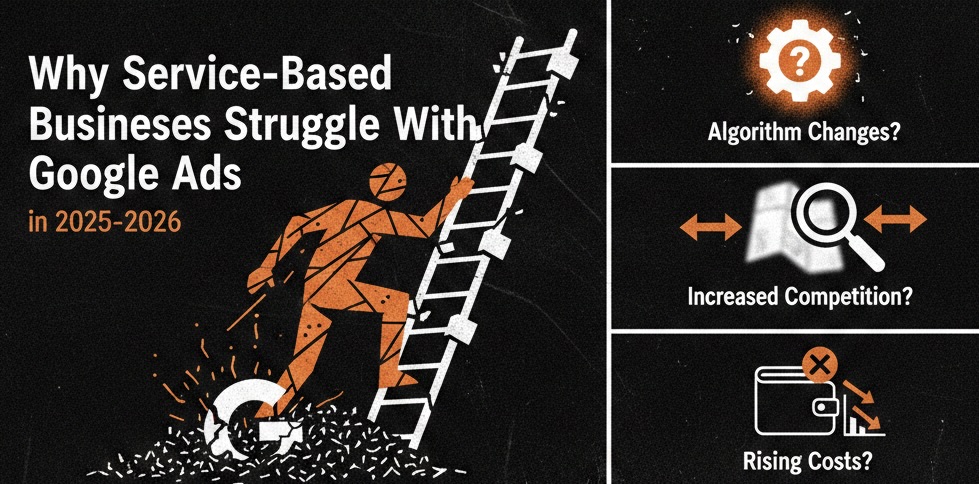
If you run a service-based business, you’ve probably noticed something frustrating over the past year: Google Ads just isn’t delivering the results it once did. Clicks have become more expensive, leads feel less qualified, and campaigns often underperform—even when following best practices. This issue isn’t limited to one industry; many service providers are facing similar challenges. Changes in Google’s ad system, increased local competition, and shifting consumer behavior have all created new hurdles, making it harder for service businesses to generate reliable leads.
Fortunately, understanding these changes is the first step toward improvement. In this guide, we dive into the main reasons why service businesses struggle with Google Ads in 2025–2026, highlighting the trends and obstacles that are reshaping paid advertising for local service providers.
1. Competition Has Surged in Local Service Industries
Over the last few years, more service providers have started advertising on Google than ever before. Between 2022 and 2025, several factors fueled this growth:
- AI tools made it easier for beginners to run campaigns
- More local contractors entered the market
- Post-pandemic demand pushed businesses online
- Google Local Service Ads (LSA) crowded the search results
Many small businesses now bid on the same high-intent keywords, including “plumber near me,” “HVAC repair,” and “roof repair near me.” As a result, costs have risen, and smaller companies often struggle to compete. To combat this, diversify keywords and focus on hyper-local or problem-based searches.
Mini Q&A:
Q: Why is local competition so fierce for service businesses?
A: The rise of AI ad tools and increased demand has led more local providers to advertise on the same high-intent keywords, driving costs up.
2. Google’s Automation Favors Big Advertisers
Google has shifted heavily toward automation, including Performance Max campaigns, broad match keywords, AI-generated creatives, and automated bidding. While these features are helpful in theory, they perform best for advertisers with large datasets and consistent conversions.
Service businesses typically receive fewer conversions, operate in limited geographic areas, and have seasonal demand. Consequently, Google’s automation may require a larger budget to optimize effectively, leaving smaller advertisers at a disadvantage. Combining smart manual strategies with automation can help level the playing field.
Mini Q&A:
Q: Can small service businesses benefit from Google Ads automation?
A: Yes, but it works best when paired with manual strategies and accurate tracking to guide optimization.
3. Intent Signals Have Become Blurry
In 2025, Google’s algorithm interprets keywords more broadly. For instance, an ad targeting “emergency electrician” might appear for:
- DIY repair tutorials
- electrical safety information
- job searches
- home improvement shopping queries
This often results in irrelevant clicks, which cost money but rarely convert. Service businesses that rely on high-intent, ready-to-book traffic feel this impact the most.
Tip: Use problem-based keywords and precise ad copy to filter out irrelevant traffic.
4. Fake Leads, Bots, and Spam Are Climbing
Lead fraud continues to be a challenge, especially for industries like locksmiths, cleaners, HVAC, and restoration services. Google Ads often struggles to filter:
- Spam form submissions
- Bot clicks
- Fake calls or competitor clicks
This increases wasted ad spend and lowers ROI. Implementing lead verification and qualification tools ensures you pay only for genuine prospects.
Mini Q&A:
Q: How can I prevent spam leads from wasting my ad budget?
A: Use tools like reCAPTCHA, phone verification, and CRM-based lead scoring to filter out low-quality leads.rospects.
5. Local Intent Keywords Are Getting More Expensive
Anything that ends with “near me” or contains strong local buying intent is now among the most expensive keyword categories.
Across many service industries, CPCs have jumped significantly from 2023 to 2025:
- Plumbing: +80%
- Roofing: +70%
- Locksmith: +120%
- HVAC: +60%
Small businesses competing in tight local areas face higher costs and reduced profitability. Targeting specific problems, emergencies, or niche services can reduce competition and improve ROI.
6. Landing Pages Often Kill Conversion Rates
Even if your ads perform well, most service business websites fail to convert because they are:
- Slow to load
- Not mobile-friendly
- Lacking clear pricing or service details
- Missing trust signals and reviews
Google drives traffic, but your landing page ultimately determines conversions. Optimizing pages for fast load times, clarity, and trust can significantly reduce cost per lead.
7. Customer Behavior Has Shifted in 2025–2026
Modern service buyers are research-driven. Many compare multiple providers before contacting anyone, check Google Maps reviews, or consult AI-generated recommendations. Additionally, platforms like TikTok and YouTube influence decisions, and users expect instant communication via WhatsApp, chat, or SMS.
This shift means fewer clicks result in immediate calls or bookings. Businesses must provide trust-building signals and multiple contact options to adapt effectively.
How Service Businesses Can Succeed with Google Ads
Struggling with Google Ads is a common challenge for service-based businesses in 2025–2026. Rising competition, automated bidding systems, and shifting customer behavior make it increasingly difficult to generate consistent, high-intent leads.
Despite these challenges, service businesses can achieve meaningful results by focusing on data-driven campaigns and accurate performance tracking. Properly managed Google Ads, combined with optimized landing pages, precise local targeting, and careful lead monitoring, can improve conversion rates and reduce wasted spend.
At Cloudix Digital, we specialize in helping service-based businesses navigate these challenges. By aligning advertising strategies with real-world lead behavior and local market conditions, we help businesses generate reliable traffic, attract qualified prospects, and maximize their return on ad spend.
Comprehensive FAQ Section
Q1: Why do service-based businesses struggle with Google Ads in 2025–2026?
They face higher competition, rising CPCs, broader keyword matching, and automated bidding that favors larger advertisers. Limited local data and inconsistent lead quality also make it harder to achieve predictable results.
Q2: How can I reduce wasted spend on Google Ads for my service business?
Focus on hyper-local targeting, high-intent keywords, problem-based queries, optimized landing pages, and lead filtering. Combining Google Ads with local SEO and reviews further improves lead quality.
Q3: Can Google Ads still generate leads for service businesses?
Yes. With the right strategy—including conversion-focused landing pages, proper tracking, lead qualification, and expert campaign management—Google Ads can remain highly profitable.
Q4: How can your services help my business with Google Ads?
We specialize in Google Ads for service-based businesses. We reduce wasted spend, target local high-intent customers, optimize landing pages, track every lead, and continually refine campaigns to generate predictable, high-quality leads.
Q5: What makes your Google Ads service different for service businesses?
Our team combines experience in service industries, advanced tracking, hyper-local targeting, and conversion-focused landing pages. We focus on ROI, not just clicks, turning ad campaigns into reliable lead-generation machines.